Iran’s feminist social revolution rages on
Source: UNC
As a wave of protests stemming from the death of a 22-year-old Iranian woman enters its second month, demonstrations have spread worldwide.
Claudia Yaghoobi, an Iranian Armenian American and the director of the Center for Middle East and Islamic Studies, answered questions from The Well about what led to the historic protests, how the fallout compares to previous conflicts and more. Yaghoobi is also the Roshan Institute Associate Professor in Persian Studies in the College of Arts and Sciences’ department of Asian and Middle Eastern studies.
What sparked the protests and who is protesting?
In September 2022, protests broke out spontaneously across the country after images appeared on social media of 22-year-old Mahsa Jina Amini, an Iranian Kurdish woman, unconscious on a hospital bed. She was declared dead on Sept. 16, three days after being arrested on a Tehran street by the morality police.
The Kurdish phrase “Jin, Jiyan, Azadi” (“Woman, Life, Freedom”), derived from years of Kurdish resistance and activism, became the slogan of this moment. Amini’s parents made a conscious decision to hold her funeral publicly even though they had been told not to. This incited protests in Saghez during the funeral when women began taking off their veils and cutting their hair. Thereafter, in almost all cities of Iran protests arose and women began cutting their hair and burning their hijabs in solidarity. The protests, or what’s been called feminist social revolution, continue to this day, as we are in the sixth week.
The protests are different in a few aspects from other protests or revolutions. For instance, they are leaderless, and people from various socio-economic gender, sexual, ethno-religious backgrounds are united. This is no longer the revolution of the educated urban middle class or upper middle class. This is a movement where all sectors of the society — Kurdish and Baluch people, men and women, the trans and queer communities, urban and rural — have come together. Mahsa Jina Amini was an ordinary woman from Saghez visiting Tehran with her family. She was not a dissident or anti-veiling activist. So, this could be anyone. And that’s why she’s united everyone.
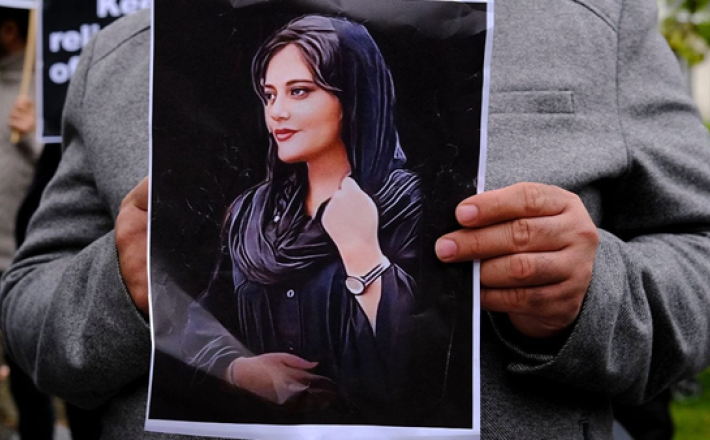
As a wave of protests stemming from the death of a 22-year-old Iranian woman enters its second month, demonstrations have spread worldwide.
Claudia Yaghoobi, an Iranian Armenian American and the director of the Center for Middle East and Islamic Studies, answered questions from The Well about what led to the historic protests, how the fallout compares to previous conflicts and more. Yaghoobi is also the Roshan Institute Associate Professor in Persian Studies in the College of Arts and Sciences’ department of Asian and Middle Eastern studies.
What sparked the protests and who is protesting?
In September 2022, protests broke out spontaneously across the country after images appeared on social media of 22-year-old Mahsa Jina Amini, an Iranian Kurdish woman, unconscious on a hospital bed. She was declared dead on Sept. 16, three days after being arrested on a Tehran street by the morality police.
The Kurdish phrase “Jin, Jiyan, Azadi” (“Woman, Life, Freedom”), derived from years of Kurdish resistance and activism, became the slogan of this moment. Amini’s parents made a conscious decision to hold her funeral publicly even though they had been told not to. This incited protests in Saghez during the funeral when women began taking off their veils and cutting their hair. Thereafter, in almost all cities of Iran protests arose and women began cutting their hair and burning their hijabs in solidarity. The protests, or what’s been called feminist social revolution, continue to this day, as we are in the sixth week.
The protests are different in a few aspects from other protests or revolutions. For instance, they are leaderless, and people from various socio-economic gender, sexual, ethno-religious backgrounds are united. This is no longer the revolution of the educated urban middle class or upper middle class. This is a movement where all sectors of the society — Kurdish and Baluch people, men and women, the trans and queer communities, urban and rural — have come together. Mahsa Jina Amini was an ordinary woman from Saghez visiting Tehran with her family. She was not a dissident or anti-veiling activist. So, this could be anyone. And that’s why she’s united everyone.